
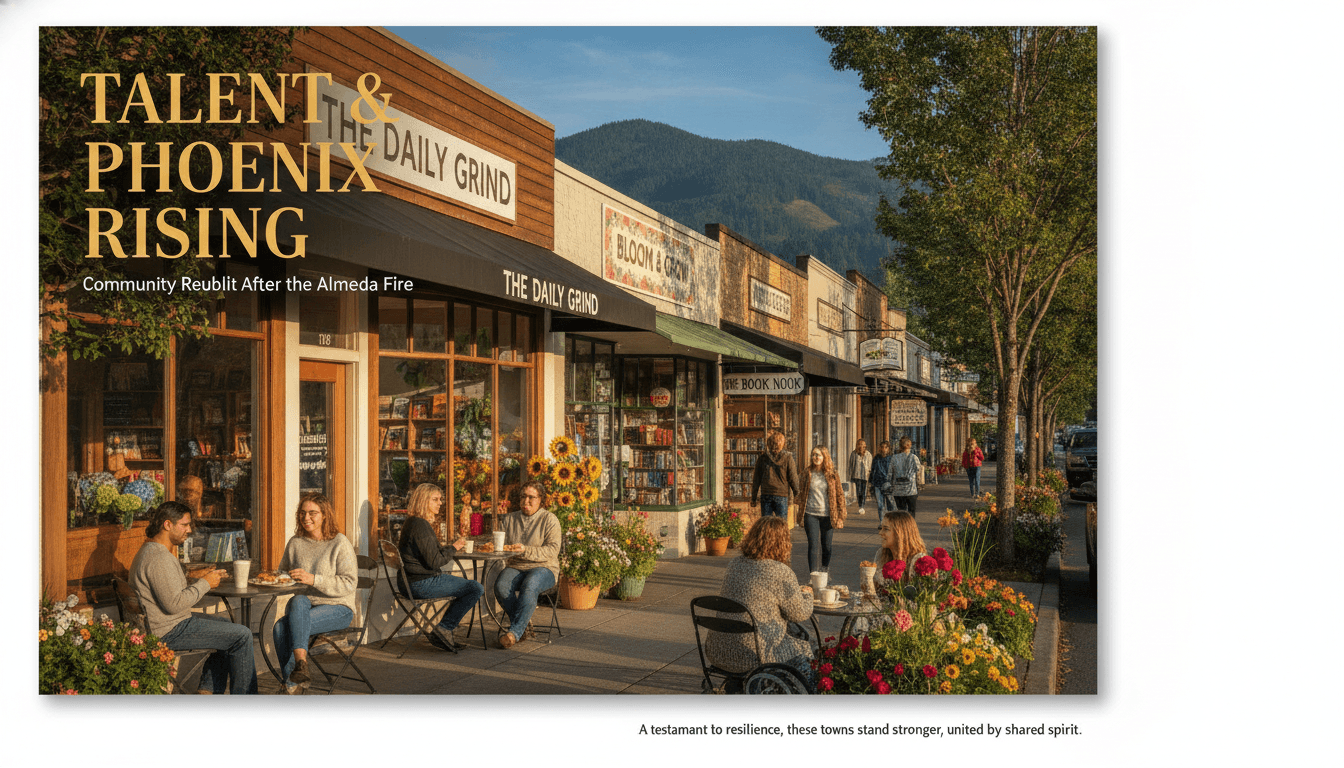
On September 8, 2020, the Almeda Fire changed life across Southern Oregon. Three people died, more than 2,600 homes vanished, and 170 businesses faced sudden closure across the Rogue Valley.
Talent lost just over 700 homes and nearly 60% of its commercial area. That loss touched jobs, services, historic buildings, and daily routines. It also tested the strength of each community.
In this article, I explore how Almeda Fire businesses used online tools, funding, and local partnerships to move forward. Their experiences show the practical side of rebuilding a business after a wildfire, from finding space to serving customers again.
I also look at Jahnke Heating and Air Conditioning, Bonnie K. Morgan, Talent Mobile Estates, and Phoenix’s different funding path. Each story reveals how people protected local identity while planning for work, housing, and long-term stability.
Local news often focuses on damage. I focus on the people who turned each empty lot into a reason to begin again.
Almeda Fire Businesses, Rebuilding a Business After a Wildfire, Southern Oregon: The Road to Recovery
Recovery took different paths across Talent and Phoenix. I found that homes returned faster than storefronts, creating an uneven return for each town. The numbers show why work, housing, and local services still needed support years later.
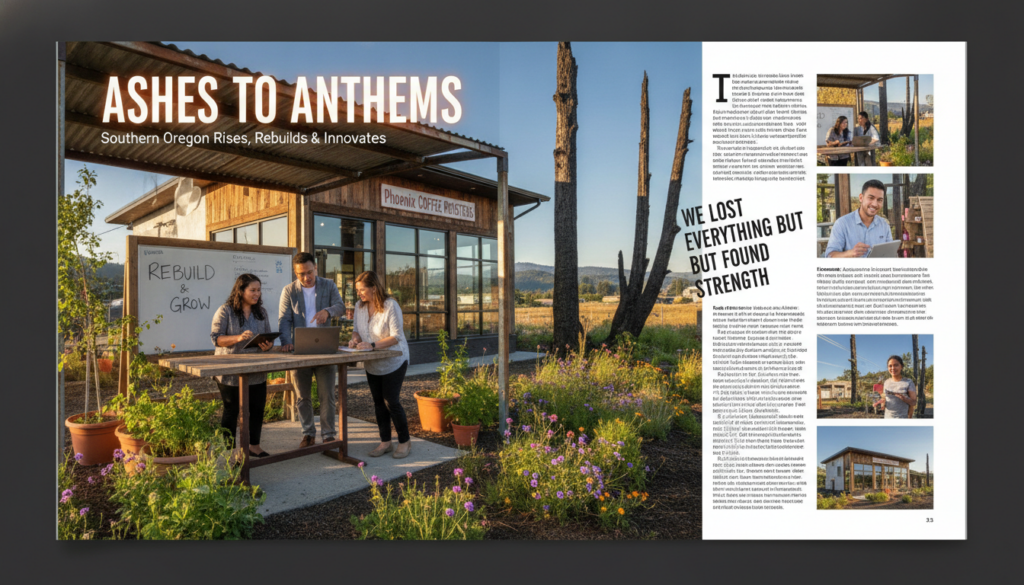
How the Almeda Fire Changed Talent and Phoenix
The Almeda Fire destroyed about one-third of Talent. More than 700 homes disappeared, and most served as naturally affordable housing. The fire destroyed roughly 60% of the town’s commercial area, including nearly two-thirds of its brick-and-mortar businesses.
Across Southern Oregon, the disaster claimed more than 2,600 homes and 170 businesses. Phoenix faced its own losses, yet different funding tools shaped its recovery. I see this contrast as one reason each city moved forward in its own way.
The Human Cost of Lost Homes, Buildings, and Businesses
Three people died, while residents lost belongings, income, and familiar places. About 85% of Talent’s housing had returned, but only 15% of commercial losses had recovered. Underinsured families often waited longer than owners with full coverage, even as new homes appeared.
| Measure | Talent impact | Recovery status |
|---|---|---|
| Homes lost | More than 700 | About 85% recovered |
| Commercial area lost | About 60% | Roughly 15% recovered |
| Regional losses | 2,600 homes and 170 businesses | Recovery remained uneven |
Jahnke Heating and Air Conditioning Keeps Serving Customers After Losing Its Talent Shop
Jahnke Heating and Air Conditioning had served Talent for 30 years when the Almeda Fire reached its shop. Its story shows how people protected essential work during sudden disruption.
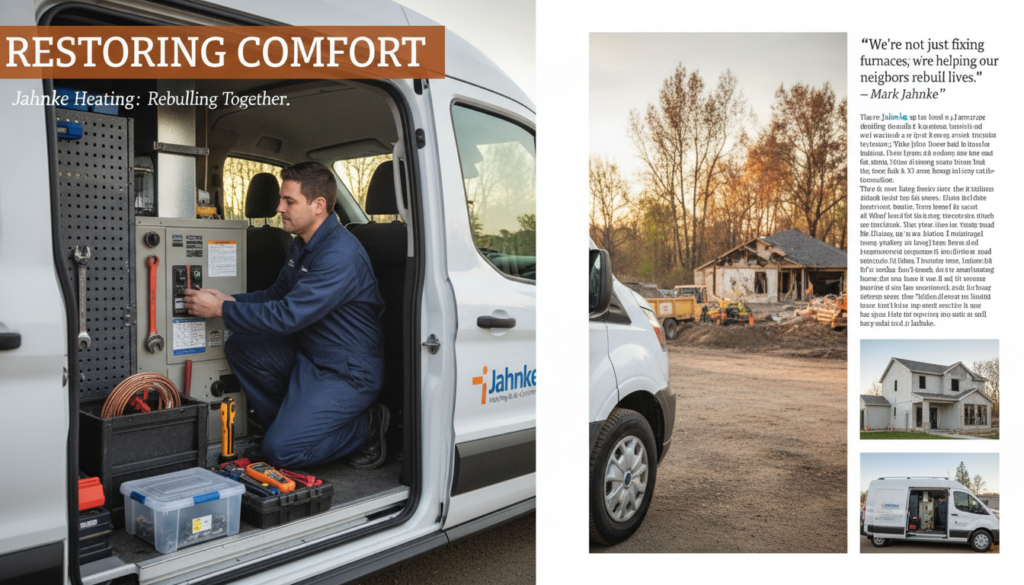
Operating From Home and White City After the Fire
Manager Jeffrey Lents said employees saved computers and software before leaving North Pacific Highway. Those tools let staff answer calls and serve customers from home the next day.
The company lost its building, shop equipment, sheet-metal operation, and several installation trucks. Many service technicians kept their vehicles, which helped crews continue work across the Rogue Valley. Owner Jeremy Richey chose to keep serving customers while planning rebuilding in Talent.
Community Support Helps Replace Tools, Equipment, and Inventory
Community members and competing businesses offered space, tools, inventory, and sheet-metal facilities. Jahnke also worked from White City during cleanup. This support gave the team time to manage insurance claims and restore its normal process.
- People: Employees protected vital digital records.
- Service: Temporary sites kept heating support active.
- Recovery: Local partners helped replace lost resources.
| Need | Response | Result |
|---|---|---|
| Shop loss | White City space | Service continued |
| Tool loss | Community offers | Crews stayed ready |
| Future site | Talent lot planning | Local presence remained |
Bonnie Morgan’s Plan to Restore Talent’s Historic Malmgren Garage
Bonnie K. Morgan owned the Malmgren Garage at 111 Talent Avenue since the late 1970s. Her plan called for more than $1 million in rebuilding funds, giving this landmark renewed purpose in the town.
Preserving the Soul of a Nearly Century-Old Building
Dr. Theodore J. Malmgren built the building in 1924 and modified it in 1925. Its masonry shell survived the Almeda Fire, preserving an important link to Talent’s commercial history. Morgan hoped rehabilitation could protect the character of nearby historic buildings while supporting the community.
Insurance, Personal Investment, and Main Street Grant Funding
The proposed funding plan combined approximately $575,000 in insurance proceeds, $235,000 from Morgan, and $200,000 through the Oregon Main Street Revitalization program. Ashland architect Jerome White, Hoppes Construction of Eagle Point, and preservation consultant George Kramer joined the project team.
- Scope: Rehabilitation and new construction for the property.
- Partners: Design, preservation, and construction experts.
- Potential impact: Morgan’s project could show nearby owners one practical way forward.
State officials received 39 applications seeking nearly $7 million, while roughly $5 million remained available. That situation made each award important. For Morgan, personal money and public funding could move the lot from uncertainty toward progress.
Why Commercial Rebuilding Has Lagged Behind Housing Recovery
The sharpest recovery divide appeared in storefronts, not rooftops. Talent restored about 85% of its homes, yet only 15% of commercial losses returned. I found that insured single-family housing moved faster because owners faced fewer design, permit, and financing hurdles.
When Insurance Could Not Cover Construction
Many owners received insurance payments below rising construction costs. Uncertain customer demand, damaged property, and added disaster risk made new loans harder to secure. That situation left people with money, but not enough money to complete each project.
Findings From the University Review
Graduate students at Southern Oregon University produced a 112-page review. It cited funding gaps, limited technical help, and future insurance concerns. The report also urged stronger planning before another wildfire affects the town.
Phoenix Used Existing Tax Growth
Talent’s proposed TIF plan failed when its fire department opposed it. Phoenix already had Tax Increment Financing in place. Mayor Darby Ayers-Flood said this strategy supported faster recovery. TIF directs future property-tax growth toward community development, rather than creating an immediate conventional tax increase.
| Recovery factor | Talent | Phoenix |
|---|---|---|
| Commercial return | About 15% | Faster progress |
| Funding tool | Proposed TIF | Existing TIF |
| Key barrier | Cost and insurance gaps | Established financing |
Affordable Housing Rebuilding Brings Residents Back Home
Housing recovery mattered just as much as storefront progress. I saw this clearly at Talent Mobile Estates, where nearly 90 of roughly 100 homes were lost when the Almeda Fire destroyed the park. Mayor Darby Ayers-Flood reported that repopulation reached about 40%.
Progress at Talent Mobile Estates
Returning residents took longer than restoring insured single-family homes. Insurance limits, rising construction costs, and limited funding slowed work. Casa of Oregon partnered with Talent on the park project, while state support and federal funding concerns shaped each step.
Transitional Housing and Protection for Mobile Home Parks
Talent froze mobile-home parks and blocked unrelated development in those locations. This strategy protected naturally affordable housing and preserved community stability. The Gateway Project offered transitional housing during recovery. Talent planned to convert that site into permanent affordable homes.
I view this approach as both practical and humane. It gave displaced residents safety, time, and support while crews handled construction. Over several years, the city linked temporary shelter with long-term housing goals, helping residents move toward home stability.
Lessons Southern Oregon Communities Can Carry Into Future Wildfires
Oregon’s 2020 fires forced more than 85,000 people to evacuate and caused roughly $6 billion in property damage. That scale showed me why local planning must begin long before smoke reaches town limits.
About one week after the Almeda Fire, leaders from Paradise, California, visited Talent and shared hard-won recovery knowledge. This peer support gave Rogue Valley officials practical ideas for permits, housing, safety, and public communication.
Keeping residents connected matters as much as replacing homes. Transitional housing allowed displaced families to remain near schools, jobs, services, and recovery work for several years. Talent also froze mobile-home parks, protecting naturally affordable housing when most local park spaces vanished.
“Prepared communities recover with greater speed, care, and purpose.”
My recommended strategy joins commercial technical help, resilient construction, insurance planning, public funding, and neighborhood partnerships. Each part supports the next. Together, they can help any city face future disasters with more stability and less delay.
Conclusion
I see Talent’s progress as shared work. Jahnke Heating and Air Conditioning and Bonnie Morgan showed how private effort can protect local jobs. Public funding from the state added vital support, while each project moved the town toward stability.
Homes and mobile-home parks mattered as much as storefronts. Talent Mobile Estates, the Malmgren Garage, and Jahnke’s company marked distinct paths through recovery. Insurance limits, rising construction costs, TIF, transitional housing, and historic preservation shaped those choices.
Reliable news can keep public needs visible and guide sound decisions. The strongest lesson is clear: community ties help people return home, protect each park, and prepare for future disasters. With careful planning and shared funding, Talent can turn hard lessons from the 2020 fire into lasting resilience.